
Due Diligence
DANIEL S. ROMERO, CFP® RECOGNIZED IN FORBES AS A 2021 BEST-IN-STATE WEALTH ADVISOR

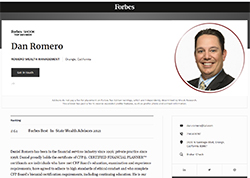
ORANGE, CA — February 2021 – Daniel S. Romero, CFP® of Romero Wealth Management was recently ranked No. 61 in California in the 2021 Best-In-State Wealth Advisors list published by Forbes.
 According to Forbes, the annual list spotlights the nation’s top-performing advisors, evaluated based on a methodology developed by SHOOK Research. Advisors are also evaluated based on personal interviews, industry experience and revenue trends, among other criteria.
“On behalf of LPL Financial, we congratulate Daniel for being recognized on this year’s Forbes Best-in-State Wealth Advisors list. This past year has demonstrated that strong financial advice cannot be underestimated, and that personalized financial advice is critical in helping clients work toward achieving their short and long-term financial goals,” said Angela Xavier, LPL executive vice president, Independent Advisor Services. “We applaud Daniel for continuing to raise the bar in our industry and demonstrate the value of the independent model in creating meaningful and long-lasting investor-advisor relationships.”
Daniel S Romero, CFP® is based in Orange, CA and provides a full range of financial services, including retirement and financial planning, individual money management, individual stocks and bonds, mutual funds, annuities and more.
Romero is an independent advisor affiliated with LPL Financial, the nation’s largest independent broker-dealer* and a leader in the retail financial advice market, providing resources, tools and technology that support advisors in their work to enrich their clients’ financial lives.
About LPL Financial
LPL Financial is a leader in the retail financial advice market and the nation’s largest independent broker-dealer*. We serve independent financial advisors and financial institutions, providing them with the technology, research, clearing and compliance services, and practice management programs they need to create and grow thriving practices. LPL enables them to provide objective guidance to millions of American families seeking wealth management, retirement planning, financial planning and asset management solutions. LPL.com
*Based on total revenues, Financial Planning magazine, June 1996-2020
LPL Financial, Forbes magazine and Romero Wealth Management are all separate entities. The Forbes Best-In-State Wealth Advisor ranking, developed by SHOOK Research, is based on in-person and telephone due diligence meetings and a ranking algorithm that includes: client retention, industry experience, review of compliance records, firm nominations; and quantitative criteria, including: assets under management and revenue generated for their firms. Portfolio performance is not a criterion due to varying client objectives and lack of audited data. Neither Forbes nor SHOOK Research receives a fee in exchange for rankings.
Securities offered through LPL Financial, Member FINRA/SIPC
Helpful Information for Filing 2020 Income Taxes & Proactive Tax Planning for 2021
Income tax is a large revenue source for the United States government. While tax rates have changed many times, since the 1860’s, the United States has used a “progressive” tax code. A progressive tax code means that people who make more money are taxed at a higher rate than those who make less money. Our progressive tax system works by placing earners through different brackets according to how much money they make. The dollar amounts define your tax brackets and there are differing tables depending on your filing status (single, married, etc.). This matters in determining your marginal tax rate.
Understanding Marginal Tax Rates
Determining your tax bracket is not as simple as just adding up your total income and checking a tax table. Taxpayers need to calculate their taxable income (which can be sometimes referred to as their “adjusted gross income”) and then adjust their income for any deductions, adjustments and exemptions they are allowed to find their final taxable amount.
Once you determine your final taxable income amount, it is critical to know that not all of your income was taxed at the same rate. For example, if you are married filing jointly, your first $19,750 is taxed at 10%. If these same tax filers have a final taxable income of $95,000, then these taxpayers are in a “marginal tax bracket” of 22%. The key thing to note is that in this example, the last dollar earned is taxed at that 22% tax rate.
2020 Tax Law Updates
2020 was a busy year for tax legislation. While there is time to look into tax planning ideas for your 2021 taxes, here are some items that 2020 tax filers should review.
- Tax brackets have been slightly adjusted.
- The standard deductions have risen from 2019.
- There are still caps to state and local tax (SALT) deductions.
- Long-term capital gains are still at favorable rates.
- There is still a 3.8% Medicare Investment Tax.
- Charitable donations are still deductible.
- You might still be able to contribute to retirement plans.
- Medical expense deductions are at 7.5% of AGI for 2020.
2020 Tax Tables and Tax Rates
There are still seven federal income tax brackets for 2020. The lowest of the seven tax rates is 10% and the top tax rate is still 37%. The income that falls into each is scheduled to be adjusted in 2021 for inflation. For 2020, use the chart in this report to see what bracket your final income falls into.
TAX TIP: If you are not sure how best to file, ask your tax preparer or review IRS Publication 17, Your Federal Income Tax, which is a complete tax resource. It contains helpful information such as whether you need to file a tax return and how to choose your filing status.
2020 Standard Deduction Amounts
Most taxpayers claim the standard deduction. For 2020, the standard deduction has slightly increased. The amounts are now $12,400 for single filers and $24,800 for those filing jointly ($18,650 for head of household filers). If you are filing as a married couple, an additional $1,300 is added to the standard deduction for each person age 65 and older. If you are single and age 65 or older, an additional deduction of $1,650 can be made.
Recovery Rebates
Under the Coronavirus Aid, Relief, and Economic Security (CARES) Act, many Americans received direct economic recovery rebate payments of $1,200 ($2,400 for couples filing jointly), plus $500 more for each child under age 17. Year-end Coronavirus related relief provided additional rebates of $600 per individual and dependent. The payments started to phase out for joint filers with adjusted gross incomes above $150,000, head-of-household filers with adjusted gross incomes (AGIs) above $112,500, and single filers with AGIs above $75,000. Technically, the rebate is an advance payment of a special 2020 tax credit. You will reconcile your rebate on your 2020 return. If you received a rebate please alert your tax preparer.
Increased Child Tax Credit
For 2020, the maximum child tax credit is $2,000 per qualifying child. Up to $1,400 of the Child Tax Credit is refundable; that is, it can reduce your tax bill to zero and you might be able to get a refund on anything left over. There is also a non-refundable credit of $500 for dependents other than children. The modified adjusted gross income threshold at which the credit begins to phase out is $200,000 and $400,000 if married filing jointly.
State and Local Tax (SALT) Deduction
Under the 2017 Tax Cuts and Jobs Act (TCJA) state and local tax deductions (SALT) remain at a combined total of $10,000 (or $5,000 for married taxpayers filing separately) for state income and property taxes. This deduction amount is set to remain through 2025.
Medical Expense Deduction
The 2020 threshold for deducting medical expenses is 7.5% of AGI. The adjusted-gross-income threshold was slated to jump from 7.5% to 10% after 2018, but Coronavirus-related relief legislation in 2020 made permanent the 7.5% figure. The IRS website, www.IRS.gov, provides a long list of expenses that qualify as “medical expenses” so it can be a good idea to keep track of yours if you think they may qualify.
| 2020 Tax Tables | ||||||
| Single Taxpayers | Married Filing Separately Taxpayers | |||||
| Up to $9,875 | 10% of taxable income | Up to $9,875 | 10% of taxable income | |||
| $9,876 to $40,125 | $987.50 plus 12% of the amount over $9,875 | $9,876 to $40,125 | $987.50 plus 12% of the amount over $9,875 | |||
| $40,126 to $85,525 | $4,617.50 plus 22% of the amount over $40,125 | $40,126 to $85,525 | $4,617.50 plus 22% of the amount over $40,125 | |||
| $85,526 to $163,300 | $14,605.50 plus 24% of the amount over $85,525 | $85,526 to $163,300 | $14,605.50 plus 24% of the amount over $85,525 | |||
| $163,301 to $207,350 | $33,271.50 plus 32% of the amount over $163,300 | $163,301 to $207,350 | $33,271.50 plus 32% of the amount over $163,300 | |||
| $207,351 to $518,400 | $47,367.50 plus 35% of the amount over $207,350 | $207,351 to $311,025 | $47,367.50 plus 35% of the amount over $207,350 | |||
| $518,401 or more | $156,235 plus 37% of the amount over $518,400 | $311,026 or more | $83,653.75 plus 37% of the amount over $311,025 | |||
| Married Filing Jointly Taxpayers | Head of Household Taxpayers | |||||
| Up to $19,750 | 10% of taxable income | Up to $14,100 | 10% of taxable income | |||
| $19,751 to $80,250 | $1,975 plus 12% of the amount over $19,750 | $14,101 to $53,700 | $1,410 plus 12% of the amount over $14,100 | |||
| $80,251 to $171,050 | $9,235 plus 22% of the amount over $80,250 | $53,701 to $85,500 | $6,162 plus 22% of the amount over $53,700 | |||
| $171,051 to $326,600 | $29,211 plus 24% of the amount over $171,050 | $85,501 to $163,300 | $13,158 plus 24% of the amount over $85,500 | |||
| $326,601 to $414,700 | $66,543 plus 32% of the amount over $326,600 | $163,301 to $207,350
|
$31,830 plus 32% of the amount over $163,300 | |||
| $414,701 to $622,050 | $94,735 plus 35% of the amount over $414,700 | $207,351 to $518,400 | $45,926 plus 35% of the amount over $207,350 | |||
| $622,051 or more | $167,307.50 plus 37% of the amount over $622,050 | $518,401 or more | $154,793.50 plus 37% of the amount over $518,400 | |||
Investment Income
Long-term capital gains are taxed at more favorable rates compared to ordinary income. For qualified dividends, investors will continue to be taxed at 0, 15% or 20%.
One tax strategy is to review your investments that have unrealized long-term capital gains and sell enough of the appreciated investments in order to generate enough long-term capital gains to push you to the top of your federal income tax bracket. This strategy could be helpful if you are in the 0% capital gains bracket and do not have to pay any federal taxes on this gain. Then, if you want, you can buy back your investment the same day, increasing your cost basis in those investments. If you sell them in the future, the increased cost basis will help reduce long-term capital gains. You do not have to wait 30 days before you buy back this investment—the 30-day rule only applies to losses, not gains.
Note: This non-taxable capital gain for federal income taxes might not apply to your state.
TAX TIP: Remember that marginal tax rates on long-term capital gains and dividends can be higher than expected. The 3.8% surtax can raise the effective rate to 18.8% for single filers with income from $200,000 to $441,500 and 23.8% for single filers with income above $441,500. It can raise the effective rate to 18.8% for married taxpayers filing jointly with income from $250,000 to $496,600 and to 23.8% for married taxpayers filing jointly with income above $496,600.
Calculating Capital Gains and Losses
With all of the different tax rates for different types of gains and losses in your marketable securities portfolio, it is probably a good idea to familiarize yourself with some of the rules:
- Short-term capital losses must first be used to offset short-term capital gains.
- If there are net short-term losses, they can be used to offset net long-term capital gains.
- Long-term capital losses are similarly first applied against long-term capital gains, with any excess applied against short-term capital gains.
- Net long-term capital losses in any rate category are first applied against the highest tax rate long-term capital gains.
- Capital losses in excess of capital gains can be used to offset up to $3,000 ($1,500 if married filing separately) of ordinary income.
- Any remaining unused capital losses can be carried forward and used in the same manner as described above.
TAX TIP: Please remember to look at your 2019 income tax return Schedule D (page 2) to see if you have any capital loss carryover for 2020. This is often overlooked, especially if you are changing tax preparers.
Please double-check your capital gains or losses. If you sold an asset outside of a qualified account during 2020, you most likely incurred a capital gain or loss. Sales of securities showing the transaction date and sale price are listed on the 1099 generated by the financial institution. However, your 1099 might not show the correct cost basis or realized gain or loss for each sale. You will need to know the full cost basis for each investment sold outside of your qualified accounts, which is usually what you paid for it, but this is not always the case.
3.8% Medicare Investment Tax
The year 2020 is the eighth year of the net investment income tax of 3.8%. It is also known as the Medicare surtax. If you earn more than $200,000 as a single or head of household taxpayer, $125,000 as married taxpayers filing separately or $250,000 as married joint return filers, then this tax applies to either your modified adjusted gross income or net investment income (including interest, dividends, capital gains, rentals, and royalty income), whichever is lower. This 3.8% tax is in addition to capital gains or any other tax you already pay on investment income.
It is helpful to pay attention to timing, especially if your income fluctuates from year to year or is close to the $200,000 or $250,000 amount. Consider realizing capital gains in years when you are under these limits. The inclusion limits may penalize married couples, so realizing investment gains before you tie the knot may help in some circumstances. This tax makes the use of depreciation, installment sales, and other tax deferment strategies suddenly more attractive.
Medicare Health Insurance Tax on Wages
If you earn more than $200,000 in wages, compensation, and self-employment income ($250,000 if filing jointly, or $125,000 if married and filing separately), the Affordable
Care Act levies a special 0.9% tax on your wages and other earned income. You’ll pay this all year as your employer withholds the additional Medicare Tax from your paycheck. If you’re self-employed, plan for this tax when you calculate your estimated taxes.
| Retirement Plan | 2020 Limit |
| Elective deferrals to 401(k), 403(b), 457(b)(2), 457(c)(1) plans | $19,500 |
| Contributions to defined contribution plans | $57,000 |
| Contributions to SIMPLEs | $13,500 |
| Contributions to traditional IRAs | $6,000 |
| Catch-up Contributions to 401(k), 403(b), 457(b)(2), 457(c)(1) plans | $6,500 |
| Catch-up Contributions to SIMPLEs | $3,000 |
| Catch-up Contributions to IRAs | $1,000 |
If you’re employed, there’s little you can do to reduce the bite of this tax. Requesting non-cash benefits in lieu of wages won’t help—they’re included in the taxable amount. If you’re self-employed, you may want to take special care in timing income and expenses (especially depreciation) to avoid the limit.
Charitable Gifts and Donations
The Coronavirus Aid, Relief, and Economic Security (CARES Act) created a new charitable deduction available to taxpayers who do not itemize their deductions in 2020. This new benefit known as a universal deduction, allows for an above the line charitable deduction of up to $300 (this increases to up to $600 for those married filing jointly in 2021). To qualify, the charitable gift must be cash (or cash equivalent) made to a qualified charity (501(c)(3)). To qualify, this contribution should have been made on or before December 31, 2020.
For those who are itemizing, in 2020, the CARES Act allow you to take deductions up to 100% of your 2020 AGI (up from 60%) for cash contributions to qualified charities.
When preparing your list of charitable gifts, remember to review your checkbook register so you do not leave any out. Everyone remembers to count the monetary gifts they make to their favorite charities, but you should count noncash donations as well. Make it a priority to always get a receipt for every gift. Keep your receipts. If your contribution totals more than $250, you will also need an acknowledgement from the charity documenting the support you provided. Remember that you will have to itemize to claim this deduction, but when filing, the expenses incurred while doing charitable work often is not included on tax returns.
You can’t deduct the value of your time spent volunteering, but if you buy supplies for a group, the cost of that material is deductible as an itemized charitable donation. You can also claim a charitable deduction for the use of your vehicle for charitable purposes, such as delivering meals to the homebound in your community or taking your child’s Scout troop on an outing. For 2020, the IRS will let you deduct that travel at .14 cents per mile.
Child and Dependent Care Credit
Although COVID-19 halted in-person school attendance for most children, typically, millions of parents claim the child and dependent care credit each year to help cover the costs of after-school daycare while working. Some parents overlook claiming the tax credit for childcare costs during the summer. This tax break can also apply to summer day camp costs. The key is that for deduction purposes, the camp can only be a day camp, not an overnight camp. In 2020, if you paid a daycare center, babysitter, summer camp, or other care provider to care for a qualifying child under age 13 or a disabled dependent of any age, you may qualify for a tax credit of up to 35% of qualifying expenses of $3,000 for one child or dependent, or up to $6,000 for two or more children.
Contribute to Retirement Accounts
The SECURE Act allowed people with earned income to make contributions to Traditional IRAs past the age of 70½ starting in 2020.
If you have not already funded your retirement account for 2020, consider doing so by April 15, 2021. That’s the deadline for contributions to a traditional IRA (deductible or not) and a Roth IRA. However, if you have a Keogh or SEP and you get a filing extension to October 15, 2021, you can wait until then to put 2020 contributions into those accounts. To start tax-advantaged growth potential as quickly as possible, however, try not to delay in making contributions. If eligible, a deductible contribution will help you lower your tax bill for 2020 and your contributions can grow tax deferred.
To qualify for the full annual IRA deduction in 2020, you must either: 1) not be eligible to participate in a company retirement plan, or 2) if you are eligible, there is a phase-out from $65,000 to $75,000 of MAGI for singles and from $104,000 to $124,000 for married taxpayers filing jointly. If you are not eligible for a company plan but your spouse is, your traditional IRA contribution is fully-deductible as long as your combined gross income does not exceed $196,000. For 2020, the maximum IRA contribution you can make is $6,000 ($7,000 if you are age 50 or older by the end of the calendar year). For self-employed persons, the maximum annual addition to SEPs and Keoghs for 2020 is $57,000.
Although contributing to a Roth IRA instead of a traditional IRA will not reduce your 2020 tax bill (Roth contributions are not deductible), it could be the better choice because all qualified withdrawals from a Roth can be tax-free in retirement. Withdrawals from a traditional IRA are fully taxable in retirement. To contribute the full $6,000 ($7,000 if you are age 50 or older by the end of 2020) to a Roth IRA, you must have MAGI of $124,000 or less a year if you are single or $196,000 if you are married and file a joint return. If you have any questions on retirement contributions, please call us.
Roth IRA Conversions
A Roth IRA conversion is when you convert part or all of your traditional IRA into a Roth IRA. This is a taxable event. The amount you converted is subject to ordinary income tax. It might also cause your income to increase, thereby subjecting you to the Medicare surtax. Roth IRAs grow tax-free and qualified withdrawals are tax-free in the future, a time when tax rates might be higher.
Whether to convert part or all of your traditional IRA to a Roth IRA depends on your particular situation. It is best to prepare a tax projection and calculate the appropriate amount to convert. Remember—you do not have to convert all of your IRA to a Roth. Roth IRA conversions are not subject to the pre-age 59½ penalty of 10%.
Many 401(k) plan participants (if their plan allows) can convert the pre-tax money in their 401(k) plan to a Roth 401(k) plan without leaving the job or reaching age 59½. There are a number of pros and cons to making this change. Please call us to see if this makes sense for you.
Required Minimum Distributions (RMD)
The SECURE Act increased the age for Required Minimum Distributions (RMD) starting January 1, 2020 to age 72. (This change only applies to account owners who turn 70½ after 2019.) Under previous law, participants were generally required to begin taking distributions from their retirement plan at age 70½.
Reminder: The CARES Act allowed you to not take your RMDs in 2020. If you took an RMD in 2020, you had until August 31, 2020 to roll that distribution back into your IRA and this roll back was not subject to the 60 day or one per year rule.
Other Overlooked Tax Items and Deductions
Reinvested Dividends – This is not a tax deduction, but it is an important calculation that can save investors a bundle. Former IRS commissioner Fred Goldberg told Kiplinger magazine for their annual overlooked deduction article that missing this break costs millions of taxpayers a lot in overpaid taxes.
Many investors have mutual fund dividends that are automatically used to buy extra shares. Remember that each reinvestment increases your tax basis in that fund. That will, in turn, reduce the taxable capital gain (or increases the tax-saving loss) when you redeem shares. Please keep good records. Forgetting to include reinvested dividends in your basis results in double taxation of the dividends—once in the year when they were paid out and immediately reinvested and later when they are included in the proceeds of the sale.
If you are not sure what your basis is, ask the fund or us for help. Funds often report to investors the tax basis of shares redeemed during the year. Regulators currently require that for the sale of shares purchased, financial institutions must report the basis to investors and to the IRS.
Student-Loan Interest Paid by Parents – Generally, you can deduct interest only if you are legally required to repay the debt. But if parents pay back a child’s student loans, the IRS treats the transactions as if the money were given to the child, who then paid the debt. So as long as the child is no longer claimed as a dependent, the child can deduct up to $2,500 of student-loan interest paid by their parents each year. (The parents can’t claim the interest deduction even though they actually foot the bill because they are not liable for the debt).
Charitable Gift Directly made from IRA – Individuals at least 70½ years of age can still exclude from gross income qualified charitable distributions (QCD) from IRAs of up to $100,000 per year. These distributions must be made directly to the charity and remember to double check on what counts as a qualified charity and distribution before using this tax strategy.
Helpful Tax Time Strategies
1. It is always helpful to write down or keep all receipts you think are even possibly tax-deductible. Sometimes, taxpayers assume that various expenses are not deductible and do not even mention them to their tax preparer. Don’t assume anything—give your tax preparer the chance to tell you whether something is or is not deductible.
2. Be careful not to overpay Social Security taxes. If you received a paycheck from two or more employers and earned more than $137,700 in 2020 you may be able to file a claim on your return for the excess Social Security tax withholding.
3. Don’t forget items carried over from prior years because you exceeded annual limits, such as capital losses, passive losses, charitable contributions and alternative minimum tax credits.
4. Check your 2019 tax return to see if there was a refund from 2019 applied to 2020 estimated taxes.
5. Calculate your estimated tax payments for 2021 very carefully. Many computer tax programs will automatically assume that your income tax liability for the current year is the same as the prior year. This is done to avoid paying penalties for underpayment of estimated income taxes. However, in some cases this might not be a correct assumption, especially if 2020 was an unusual income tax year due to the sale of a business, unusual capital gains, the exercise of stock options, or even winning the lottery! A qualified tax preparer could be able to help you with a tax projection for 2021.
6. Remember that IRS.gov could be a valuable online resource for tax information.
7. Always double check your math where possible and remember it is always wise to consult a tax preparer before filing.
Proactive Tax Planning for 2021
Items Taxpayers Could Consider to Proactively Tax Plan for 2021 Include:
1. Prepare a 2021 tax projection – Taxpayers already know the 2021 rates and by reviewing their 2020 situation and all 2021 expectations of income, a qualified tax preparer could be able to help you with a tax projection for 2021.
2. New contribution limits for retirement savings – For 2021, the contribution limit for employees who participate in 401(k), 403(b), most 457 plans, and the federal government’s Thrift Savings Plan remains at $19,500. The limit on annual contributions to an IRA also remains unchanged at $6,000 ($7,000 for those 50 or older). The catch-up contribution limits for those 50 and over remain unchanged at $1,000.
3. Explore if a potential Roth IRA conversion is helpful for your situation – A Roth IRA can be beneficial in your overall retirement planning. Investments in a Roth IRA have the potential to grow tax-free and they do not have required minimum distributions during the lifetime of the original owner. Also, Roth IRA assets may pass to your heirs tax-free. Roth conversions include complex details and are not right for everyone, so please call us to see if this makes sense for you.
4. Take advantage of annual exclusion gifts – For 2021, the maximum amount of gift tax exemption is $15,000. This means you can give up to that amount to a family member without having to pay a gift tax. Ideas for gifting can include, contributing to a working child (or grandchild’s) IRA, or gifting to a 529 plan, which is a tax-sheltered plan for college expenses.
5. Consider bunching your charitable donations into a Donor Advised Fund (DAF) – Now is the time to explore if it is helpful for your tax situation to deposit cash, appreciated securities or other assets in a Donor Advised Fund, and then distributing the money to charities over time. Up to 60% of your adjusted gross income can be deductible if given as donations to typical charities.
6. The new above the line charitable deduction increases from $300 to $600 for taxpayers married filing jointly.
Potential Tax Changes based on Public Policy that President Biden has discussed.
When President Biden was running for office, his campaign released several tax law changes that he felt we should make if he is elected. While these proposals are not law, it still could be helpful to be aware of them, so if they are considered, you can be better prepared. Some of the changes proposed to be aware of are:
Increase Corporate Tax Rates. Under the TCJA, the peak marginal corporate tax rate was reduced from 35% to 21%. Under the Biden tax plan, the corporate tax rate would be increased to 28%.
Increase the marginal tax rate for top earners. Biden’s tax plan would raise the top marginal income-tax bracket from 37% to 39.6% (please note that the TCJA lowered the top marginal bracket from 39.6% to 37% in 2018).
Lift the capital gains and dividend tax rates on filers with incomes above $1 million. Biden’s tax proposal calls for filers with over $1 million in income to pay ordinary tax rates on their dividends and capital gains, no matter how long they have held an asset. This would imply 39.6%, plus the Net Investment Income Tax, for a total tax rate of over 43%.
Limit itemized deductions. Biden’s tax plan includes a cap on itemized deductions of 28%. This means for each dollar of itemized tax deductions, including charitable contributions, a taxpayer or couple filing jointly would only receive a maximum benefit of $0.28. This 28% limit would hold true even if a filer is paying a higher marginal tax rate.
Phase out small business income deductions over $400,000. Biden’s tax plan aims to keep Qualified Business Income deductions in place for those with less than $400,000 in earnings but phasing out pass-through deductions for those with over $400,000 in earnings.
Eliminate the stepped-up basis. Biden’s tax plan wants to put an end to the step-up basis. A step-up basis refers to the cost basis of assets or property transferrable to an heir upon death. For example, if an individual invested in a $300,000 marketable securities position that is worth $500,000 at the time of their death, their heir would pay capital gains on anything over $600,000 if the position were ever sold. If Biden’s tax proposal were to become law, heirs would not “inherit” a stepped-up cost basis and if they liquated the position soon after receiving it would realize $200,000 of capital gain.
Proactive Tax Planning with the SECURE Act
On December 20, 2019, the Setting Every Community Up for Retirement Enhancement (SECURE) Act was signed into law. The SECURE Act made major changes to a number of tax rules that govern retirement savings. Some changes that started in 2020 that affect retirement savers and their tax strategies include:
- The Required Minimum Distribution (RMD) age was raised from 70 ½ to 72.
- The age limit for traditional IRA contributions was eliminated.
- A new 10-year rule essentially requires most non-spouse beneficiaries take full distribution off all Inherited IRAs, Roth IRAs, and qualified plans within 10-years of the original owner’s death.
- There are new 529 Education Fund Usage Rules.
Reduce Estate Tax exemption. Biden’s tax plan wants to reduce Estate tax exemptions back down to $3.5 million per individual (currently $11.7 million per individual) immediately. This means estates over that value would be subject to estate tax.
Conclusion
Filing your 2020 taxes will continue to include the new tax rates set forth with the Tax Cuts and Jobs Act (TCJA) enacted in 2018 (currently set to expire after 2025). An essential part of maintaining your overall financial health is attempting to keep your tax liability to a minimum.
One of our primary goals is to keep you informed of the changes that will be affecting investors like you. We believe that taking a proactive approach is better than a reactive approach—especially regarding income tax strategies!
Quarterly Economic Update: Fourth Quarter 2020
There are many years that history could easily forget, but 2020 certainly will not be among them. The year 2020 challenged us in more ways than we were prepared for and the thoughts of a “Happy New Year” seemed to be more prevalent this New Year’s Eve than ever. In the investment markets, the year 2020 ended much like it began, with equities in a bull market and making fresh all-time highs. This fact might seem somewhat unsurprising if it was not for the historic events that occurred in the first quarter, namely the worst global pandemic in a century and the almost shockingly brief bear market that accompanied it. The S&P 500 has surged roughly 65% since its March low and finished the year up over 16%. (Source: forbes.com 1/2020)
The economy’s nascent recovery gets much of the credit for the market’s gains, as does a federal stimulus package, massive amounts of liquidity from the Federal Reserve and the rapid development of multiple COVID-19 vaccines.
For the new year, talks of vaccines defeating the spread of coronavirus and an economic rebound could potentially result in a time of celebration. While the economy suffered in 2020, most U.S. stock indexes ended the year at or near all-time highs and market strategists see the major indexes pushing even higher in 2021. Predictions of a stronger economy, robust profit growth and some more massive stimulus from governments and central banks are expected. These factors combined with keeping interest rates near zero have been crucial in leading this year’s rebound from the March 2020 lows.
The Dow Jones Industrial Average (DJIA) advanced in the fourth quarter eclipsing the 30,000 level while the S&P 500 also experienced gains. The DJIA finished 2020 higher by more than 7.25%, while the S&P 500 rose over 16%. (Source: cnbc.com 1/4/2020)
As you look at the year’s results, analysts remind us that a surge in technology and internet-related shares were fueling the U.S. indexes to record highs. Gains in Apple, Amazon and Microsoft alone accounted for more than half of the S&P 500’s 16% total return, according to Howard Silverblatt, Senior Index Analyst at S&P Dow Jones Indices. Analysts also feel that “valuations near 16-year highs are raising concerns about the sector’s vulnerability.” While many equities ended the year strong, technology companies were clearly amongst the best performers.

2020 was another strong year for many other asset classes. Some of the highlights included:
- Global stocks (as measured by the MSCI World Index) climbed 14%.
- Gold (as measured by NYMEX per troy ounce) soared 28%.
- Bonds (as measured by the Barclays Aggregate Bond Index) gained 5%. (Source: fidelity.com 12/31/2020)
Although equities advanced in 2020, these gains came despite a backdrop of grim news that overshadowed the year. These included:
- COVID-19 shutting down the economy and contributing to more than 300,000 deaths in the U.S.
- An almost nonstop attention to politics which caused some to read every movement of the stock market as a referendum on the election.
- Social justice unrest and the protests that followed.
- Uncertainties in many areas of life and business.

While there are always many key points and issues that need to be watched, this report’s goal is to focus on a few key themes for investors. Unlike people, equity markets do not have emotions and investors might be best served remembering that. The final quarter of 2020 will be remembered for many reasons, but perhaps none more consequential than the development of at least three viable COVID-19 vaccines. Hopefully, we entered 2021 on a path toward a daily life that is less restrictive and provides a healthy boost to the economy.
Interest Rates Remain at Ultra-Low Levels
In December, the Federal Reserve announced its decision to continue to support the economy by buying Treasury bonds. At the December press conference, Treasury Secretary Powell said that the Fed would continue to use a variety of monetary tools until officials are confident the U.S. economy is fully recovered. The Federal Reserve has suggested interest rates will remain near zero through 2023. (Source: cnbc.com 12/16/2020)
Since March, interest rates on even the highest-yielding savings accounts have been less than 1% and many times closer to 0%. While savers are generating next to nothing on cash accounts, homeowners can potentially take advantage of these low rates by refinancing their mortgages.
While interest rates are low, a fully diversified portfolio should include interest sensitive investments, like bonds. Therefore, in a period where the market rises, diversified portfolios will have lower returns than full equity portfolios. On the flip side, with equities at or near all-time highs, bonds can help protect investors in the case of a downturn. Remember, diversification is a strategy used to reduce risk by investing in different areas that could each react differently to the same event. A well-diversified portfolio looks for investments in different categories like stocks, bonds, and cash, whose returns have not historically moved in the same direction and to the same degree.
Interest rates are important for investors to monitor and they will continue to stay near the top of our watchlist, but for now, the consensus appears to be that rates are going to be low for a long time.
New Administration in 2021
Our job as financial professionals requires analyzing political activity and relaying how a new administration could impact the investment world. After one of the most contentious elections ever, with the largest voting numbers ever recorded, a new administration is taking over in January.
According to CNBC, the new Democratic control of Congress should help keep the bull market in stocks going with a big boost of fiscal spending, but it could also throw new hurdles into its path, like higher taxes and higher interest rates.
“Every Democratic president since Woodrow Wilson served their first year in office with the support of a Democratic House and Senate,” said Sam Stovall, CFRA chief investment strategist. He added during that first year, “The market did very well.” Dan Clifton, head of policy research at Strategas, expects a first stimulus to come early in the Biden administration and could include payments for individuals, funds for state and local governments, and extensions for unemployment benefits. (Source: cncb.com 1/6/2021)
Could a Democratic Congress push through stimulus programs to boost the economy that could help the stock market? Would this outweigh a tax increase? How will the new administration handle trade talks with China? All these questions and many more like them mean that investors need to carefully watch the political results of the incoming administration. Public policy and the new administration are clearly on our watchlist.
The Economy and the Stock Market
As the year ends, investors are left with the reality that there is still a wide divergence between financial markets and economic performance. Equity indexes ended the year at or near all-time highs, while Main Street still suffered from lockdowns, high unemployment and uncertainty. In March, the coronavirus pandemic brought a decade-long economic expansion and bull market to an end, but a powerful monetary and fiscal response from the Government and Treasury led to a roaring recovery in the stock market. The economy was not as fortunate, as its recovery has been uneven at best, and the rate of improvement slowed dramatically as we approached the end of the year.
Former Fed Chair Janet Yellen, who is currently President Biden’s choice for Secretary of the Treasury is remembered for famously stating that, “the stock market isn’t the economy,” but the two still inevitably reconnect over time. Hopefully, the new year brings a robust recovery in the rate of economic growth, combined with the monetary and fiscal stimulus already in the system and what is likely to be proposed by the new Congress this year. Today’s low interest rates are a foundation of the bullish narrative because they leave investors to consider higher risk stocks and bonds. While no one can predict the future with complete accuracy, many professionals are stressing, that investors need to diversify and balance their portfolios. For 2021, the economy and its ability to recover are near the top of our watchlist.

Investor Outlook
The stock market enters 2021 with favorable outlooks. Vaccines should help prevent the spread of COVID-19. S&P 500 earnings are expected to keep rebounding. The Federal Reserve has assured markets that it will not raise interest rates and there have already been some new rounds of fiscal stimulus signed into law. Please remember that the stock market is forward-looking and many prominent analysts feel that it has already priced in a stronger economy and the pausing of the coronavirus pandemic. That raises the risk that any disappointment in the recovery will rattle investors, especially with the P/E (price-to-earnings) ratio of the S&P 500 at a high level. This has caused some leading market followers to argue that the stock market is overvalued.
Most analysts are optimistic for 2021. Barron’s recently surveyed 10 market strategists and chief investment officers at large banks and money-management firms on the outlook for 2021. Averaging their year-end S&P 500 forecasts, which range from 3800 to 4400, the group expects the index to rise 9% in 2021 to about 4040. Add a dividend yield of around 2% and U.S. stocks could return a total of 10% to 11%. Their panel predicts the U.S. economy will grow by 5% in 2021, its fastest rate since 1984.
Predicting short term changes in the equity markets is still near impossible. Equities are primarily for long term investors. With interest rates at or near zero, investors who need returns need to consider equities.
With 10-year Treasuries yielding around 1%, equities become even more noticeable on an investor’s choice list. Equity markets will continue to move up and down. Even if your time horizons are long, you could see some short-term downward movements in your portfolios. For 2021, caution is still the principal notion for investors. Our goal is to make sure your investing plan is centered on your personal goals and timelines.
Strategies for Investors in Uncertain Times
After one of the most contentious presidential elections in recent history, as of November 6th, the election results are still not finalized and they might be contested for the foreseeable future. A new administration could bring changes, so we thought it would be helpful to review some information to think about if Joe Biden becomes the next President. Amongst many experts, preliminary discussions suggest that if we have a divided Congress (Republican Senate and a Democratic House of Representatives) gridlock may continue for the foreseeable future.
While the final election results are still being calculated, the outcomes of two longer-term unknowns are still centerstage: (1) the continuing evolution of the COVID-19 pandemic and its impact on the economy, the markets and human conditions; and (2) the continuation of massive debt and deficit spending. On the first issue, we will hopefully have a reasonably optimistic outlook in the near future. We all look forward to a time where vaccines and effective therapies are available. We do not know exactly when, but we are optimistic that day will come. The second issue is more financially driven. While the country is borrowing from the future to help circumstances today in a completely bipartisan manner, eventually these borrowings will need to be repaid. This could result in lower growth or higher taxes at some point in the future, but that still needs to be determined.
An immediate unknown is the state of additional fiscal stimulus legislation. This will be a known outcome if a package is agreed upon prior to year-end. The actual outcome of any stimulus package may be quite different if it is not enacted until next year.
Just days before the 2020 U.S. elections, President Trump plugged record economic growth in a last-ditch effort to persuade voters to re-elect him. Democratic rival Joe Biden said the U.S. is stuck in a “deep hole” and that the recovery is in danger of stalling.
Who’s right? The presidential candidates have sharply contrasting views on the economy, but they are both telling a version of the truth. The economy has recovered from the coronavirus pandemic faster than expected, but by some measures the nation still remains in a recession. Also, the record rise in daily new coronavirus cases in October threatened to stall a recovery that was already losing momentum. (Source: MarketWatch 11/1/2020)
Given that backdrop, we still need to focus on helping our clients pursue their financial goals. While it’s not yet possible to time travel, it’s still critical that we plan for the future. Voting is an important right that gives us a say in who our leaders are, but it is not a reason to change your fundamental financial goals. Equity investments are never going to produce straight line returns for investors, but in today’s low interest rate environment they are a cornerstone of many portfolios.
As an immediate reaction to the election, equity markets rose rapidly, which is good for investors. However, investors still should prepare for a reaction to uncertainty and volatility, which could potentially bring equity markets down quickly. During volatile times, many investors get agitated and begin to question their fundamental investment decisions and choices. This is especially true for those investors who monitor their portfolios daily and can sometimes be tempted to pull out of the market altogether and wait on the sidelines until it seems safe to dive back in. One thing that can help is to understand that equity market volatility is part of the investment cycle. Investment markets can always move up and down, especially over the short-term. Pullbacks are often not a time to panic and should rather be used as a reason to analyze and assess. Under certain circumstances, it may even be the case that a pullback represents an attractive buying opportunity for certain portfolios. Some experts suggest that investors need to remember that the only certainties in life are death, taxes and market volatility.
Short-term movements of the market are unpredictable and do not abide by any average.
At any time, the equity markets could see a retreat of 10% or more. Our firm attempts to not act on emotion. We try to put market events in context to determine what they mean. Market pullbacks (defined typically as between 5 and 10%), corrections (defined as 10 to 20%) and even bear markets (defined as 20% or more) are a normal part of the stock market cycle. Investors can gain important perspective on market pullbacks by considering post-World War II declines in the S&P 500 Index. Research by Guggenheim Investments showed that the majority of declines fell within the 5-10% range with an average recovery time of approximately one month. Market declines between 10-20% had an average recovery period of approximately four months. They concluded that pullbacks within these ranges are not uncommon and occurred frequently during the normal market cycle. While they can be emotionally unnerving, they generally will not fully undermine a well-diversified portfolio and are not necessarily signals for investors to panic. Even more severe pullbacks of 20-40% registered an average recovery period of only 15 months. (Source: GuggenheimInvestments.com)

Here are five general guidelines that might be helpful to review, especially if the equity markets become more volatile.
1. Focus on only investing money in equities that you can earmark for at least five years.
Over long periods, equity markets have produced positive returns for many investors. However, the long term is usually longer than five years. Investors who allocate money that they need in the short term to equities run a greater risk that they might end up having to sell during a prolonged bear market, and therefore would face losses because of it. Investors should try to avoid putting their assets in this position. They should consider keeping the money they will need in the short term out of the market.
2. Make equity investments that you feel comfortable holding for the long-term.
One of the most difficult ways to advance your wealth is to speculate and try to make a quick return in the equity markets. If you do this at the wrong time, you could get end up with losses or stuck holding positions you might not want in a prolonged downturn. Legendary investor Warren Buffett has been noted for advising, “you shouldn’t hold a stock for 10 minutes if you wouldn’t feel comfortable holding it for 10 years”.
3. Maintain an appropriate asset allocation for your risk tolerance and time frames.
When constructing your portfolio, a good measure is to not invest money you’ll need soon in equities and to respect your personal risk tolerance. In today’s low interest rate environment, you need to consider investing in equities to potentially earn reasonable returns and potentially build wealth, but by doing so you take on greater risk. For younger investors who have a long-time horizon, they can consider taking on more risk than an older investor who might consider safer, but lower returning investments.
This is where talking with us about your goals, time horizons and risk tolerances can be helpful. As financial professionals, we try to make recommendations based upon understanding your personal circumstances and preferences.
4. Consider a diversified portfolio
A diversified investment portfolio is typically one that consists of various assets that attempt to earn the best return with less risk. A typical diversified portfolio has a mixture of equity and fixed income investments. Traditionally, equities can perform best when the economy is growing and fixed income is a more stable holding when the economy is struggling. A common theme for many investors is to use asset allocation to determine their exact mix of equities and fixed income holdings. Your portfolio can depend on your comfort with different risk levels, your goals, and where you are in life.
5. Use professional guidance.
Sir John Templeton was one of the greatest investors and fund managers ever. One of his famous quotes was, “The only way to avoid mistakes is not to invest—which is the biggest mistake of all.” Another was, “Do your homework or hire wise experts to help you.” This is where we can offer some assistance. We will always consider your feelings about risk and the markets and review your unique financial situation when making recommendations.
Note: The views stated in this letter are not necessarily the opinion of Romero Wealth Management and should not be construed, directly or indirectly, as an offer to buy or sell any securities mentioned herein. Investors should be aware that there are risks inherent in all investments, such as fluctuations in investment principal. With any investment vehicle, past performance is not a guarantee of future results. Material discussed herewith is meant for general illustration and/or informational purposes only, please note that individual situations can vary. Therefore, the information should be relied upon when coordinated with individual professional advice. This material contains forward looking statements and projections. There are no guarantees that these results will be achieved.
All indices referenced are unmanaged and cannot be invested into directly. Unmanaged index returns do not reflect fees, expenses, or sales charges. Index performance is not indicative of the performance of any investment. The S&P 500 is an unmanaged index of 500 widely held stocks that is general considered representative of the U.S. Stock market. Dow Jones Industrial Average (DJIA), commonly known as “The Dow” is an index representing 30 stock of companies maintained and reviewed by the editors of the Wall Street Journal. Past performance is no guarantee of future results. Due to volatility within the markets mentioned, opinions are subject to change without notice.
Information is based on sources believed to be reliable; however, their accuracy or completeness cannot be guaranteed. This information is not intended to be a substitute for specific individualized tax advice. We suggest that you discuss your specific situation with a qualified tax professional. Asset allocation and diversification are methods used to help manage investment risk; they do not guarantee a profit or protect against investment loss.
Sources: MarketWatch 11/1/2020, GuggenheimInvestments.com, The Motley Fool, WisdomTree.com. Contents Provided by The Academy of Preferred Financial Advisors; Academy of Preferred Financial Advisors, Inc.© 2020
Annual Plan Limits
| Plan Limits | 2025 | 2024 |
|---|---|---|
| 401(k) Elective Deferral Limit | $23,500 | $23,000 |
| Catch-Up Contribution Limit* | $7,500 | $7,500 |
| Annual Defined Contribution Limit | $70,000 | $69,000 |
| Annual Compensation Limit | $350,000 | $345,000 |
| Annual Defined Benefit Limit | $280,000 | $275,000 |
| Highly Compensated Employee Dollar Limit | $160,000 | $155,000 |
| Key Employee Dollar Limit | $230,000 | $220,000 |
*Under a change made in SECURE 2.0, a higher catch-up contribution limit applies for employees aged 60, 61, 62 and 63 who participate in 401(k), 403(b), 457 and Thrift Savings plans. For 2025, this higher catch-up contribution limit is $11,250.
| Related Limits | 2025 | 2024 |
|---|---|---|
| 403(b)/457 Elective Deferral Limit | $23,500 | $23,000 |
| SIMPLE Employee Deferral Limit | $16,500 | $16,000 |
| SIMPLE Catch-Up Deferral Limit | $3,500 | $3,500 |
| SEP Minimum Compensation Limit | $TBA | $750 |
| SEP Annual Compensation Limit | $350,000 | $345,000 |
| Social Security Taxable Wage Base | $176,100 | $168,600 |
| Self-only HSA Contribution Limit | $4,300 | $4,150 |
| Family HSA Contribution Limit | $8,550 | $8,300 |
| HSA Catch-Up Contribution Limit | $1,000 | $1,000 |
| IRA Contribution Limit | $7,000 | $7,000 |
| IRA Catch-Up Contribution Limit | $1,000 | $1,000 |
The information provided is not intended to be a substitute for specific individualized tax planning or legal advice. We suggest that you consult with a qualified tax or legal professional.
ART # 657663
Quarterly Economic Update: Third Quarter 2020
Nearly six months after the large waterfall drop of equity prices in March, most broad indexes have found their way to a better place. For the third quarter, the Dow Jones Industrial Average (DJIA) advanced over 7% and the S&P 500 index (S&P 500) rose over 8%. Although the quarter was strong, the month of September brought these two major indexes their first negative returns since March. For September, the DJIA moved over 2% lower, while the S&P 500 was down almost 4%. Many media outlets reported that the late September decline was because developments on Capitol Hill overshadowed the positive data on housing and jobs that had been a focus for much of the quarter. (Source: MarketWatch 9/30/2020)

Positive signs for the quarter included the fact that home-contract signings were at a record high in August, according to the National Association of Realtors. Also, Automatic Data Processing said 749,000 private-sector jobs had been created in September, ahead of estimates for a gain of 650,000, and the strongest reading in three months. (Source: MarketWatch 9/30/2020)
Not all the statistics released this quarter were healthy. For example, the Commerce Department revealed on September 29th that personal income—a measure of what Americans received from salaries, investments, and government assistance programs—fell 2.7% in August from a month earlier. The data showed that this decline was due entirely to a drop in unemployment benefits. While the quarter included many inconsistent data points, the overriding theme for many investors is that there is still a high degree for concern as we await more positive data on potential coronavirus treatments. (Source: Wall Street Journal 10/1/2020)
The Federal Reserve has pledged to keep interest rates low for years and so the days of relying on strong returns from money market accounts and certificates of deposit may be in the rear-view mirror. While many investors this quarter enjoyed an increase in equity prices, some analysts caution that based on historical numbers, like price earnings, the case can be made that equities are highly overvalued and overpriced. Others debate that with ultra-low interest rates and high levels of liquidity, equities are still attractive.
This quarterly update’s goal is to focus on a few of the central themes for investors. With markets entering Fall, a time period that has historically been associated with heavy volatility, investors should consider focusing on their personal objectives and timeframes.

Key Points
1.Equity markets had strong results for the third quarter.
2.Interest rates are still in the spotlight as the Fed says they will keep rates near 0% till 2023.
3.Unemployment strengthened, but the economy is still challenging.
4.The U.S. political situation adds to the current environment of uncertainty.
5.Investors should fully commit to realistic time horizons.
6.Now is the ideal time to revisit your personal objectives and the strategies to achieve them.
7.Call us with any questions.
Proactive Year-end Tax Planning for 2020 and Beyond
One of our main goals as holistic financial professionals is to help our clients recognize tax reduction opportunities within their investment portfolios and overall financial planning strategies. Staying current on the ever-changing tax environment is a key component to help our clients benefit from potential tax reduction strategies.
2020 was an unusual year that had several major legislative bills passed that could have an impact on your taxes. It is also a presidential election year, so investors might want to think about potential future tax strategies. Although it will take more than a change in president to enact tax laws changes, it is always wise to educate yourself in advance. This report includes sections on possible tax law changes if there is a change in administration (based on the current proposals) and notable CARES Act and SECURE Act changes that you should be aware of. The main focus of this report is on what individual taxpayers can do to potentially save money on their 2020 taxes.
The Tax Cuts and Jobs Act (TCJA) enacted in 2017 brought many changes to the tax code. One big uncertainty for all taxpayers is what will happen to the Tax Code after 2025. The way the Tax Cuts and Jobs Act is set up, the changes to the corporate side of the tax code are permanent while many provisions for individuals that took effect in 2018 are currently set to expire after 2025.
The objective of this report is to share strategies that could be effective if considered and implemented before year-end. Please note that this report is not a substitute for using a tax professional. In addition, many states do not follow the same rules and computations as the federal income tax rules. Make sure you check with your tax preparer to see what tax rates and rules apply for your particular state.
Income Tax Rates for 2020
For 2020 there are still seven tax rates. They are 10%, 12%, 22%, 24%, 32%, 35%, and 37%.
Under current law this seven-rate structure will phase out on January 1, 2026.
For 2020 there are still seven tax rates. They are 10%, 12%, 22%, 24%, 32%, 35%, and 37%.
Under current law this seven-rate structure will phase out on January 1, 2026.
| Tax Rate | Single | Married/Joint & Widow(er) |
Married/Separate | Head of Household |
| 10% | $0 to $9,875 | $0 to $19,750 | $0 to $9,875 | $0 to $14,100 |
| 12% | $9,876 to $40,125 | $19,751 to $80,250 | $9,876 to $40,125 | $14,101 to $53,700 |
| 22% | $40,126 to $85,525 | $80,251 to $171,050 | $40,126 to $85,525 | $53,701 to $85,500 |
| 24% | $85,526 to $163,300 | $171,051 to $326,600 | $85,526 to $163,300 | $85,501 to $163,300 |
| 32% | $163,301 to $207,350 | $326,601 to $414,700 | $163,301 to $207,350 | $163,301 to $207,350 |
| 35% | $207,351 to $518,400 | $414,701 to $622,050 | $207,351 to $311,025 | $207,351 to $518,400 |
| 37% | $518,401 or more | $622,051 or more | $311,026 or more | $518,401 or more |
Year-end Tax Planning for 2020
2020 is the third year for the new tax laws and new tax forms that were created by the 2017 Tax Cuts and Jobs Act (TCJA). One of our primary goals is to help our clients try to optimize their tax situations. This report offers many suggestions and reviews strategies that can be useful to achieve this goal.
Everyone’s situation is unique but it is wise for every taxpayer to begin their final year-end planning now! Choosing the appropriate tactics will depend on your income as well as a number of other personal circumstances. As you read through this report it could be helpful to note those strategies that you feel may apply to your situation so you can discuss them with your tax preparer.
Some items to consider include:
— Evaluate the use of itemized deductions versus the standard deduction
For 2020, the standard deduction amounts will increase to $12,400 for individuals and married couples filing separately, $18,650 for heads of household, and $24,800 for married couples filing jointly and surviving spouses.
As a reminder, in 2018, the Tax Cuts and Jobs Act roughly doubled the standard deduction. It’s reported that this helped decrease tax payments for many of those who typically claim this standard deduction. Although personal exemption deductions are no longer available, the larger standard deduction, combined with lower tax rates and an increased child tax credit, could result in less tax. You should consider running the numbers to assess the impact on your situation before deciding to take itemized deductions.
The TCJA still eliminates or limits many of the previous laws concerning itemized deductions. An example is the state and local tax deduction (SALT), which is now capped at $10,000 per year, or $5,000 for a married taxpayer filing separately.
— Consider bunching charitable contributions or using a donor-advised fund
For many taxpayers, the larger standard deduction and changes to key itemized deductions resulted in them no longer itemizing. It was estimated that about 15 million filers used the charitable contribution write-off in 2018, a sharp decline from the 36 million who utilized it in 2017. For those taxpayers who are charitably inclined it makes sense to think about a plan. One way to utilize the tax advantages of charitable contributions is through a strategy referred to as “bunching”. Bunching is the consolidation of donations and other deductions into targeted years so that in those years, the deduction amount will exceed the standard deduction amount. (wsj.com 2/15/2019)
Another strategy is to consider using a donor-advised fund. A donor-advised fund, or DAF, is a philanthropic vehicle established at a public charity. It allows donors to make a charitable contribution, receive an immediate tax benefit and then recommend grants from the fund over time. Taxpayers can take advantage of the charitable deduction when they’re at a higher marginal tax rate while actual payouts from the fund can be deferred until later. It can be a win-win situation. If you are charitably inclined and need some guidance, please call us and we can assist you.
— Review your home equity debt interest
For mortgages taken out after October 13, 1987, and before December 16, 2017, mortgage interest is fully deductible up to the first $1,000,000 of mortgage debt. The threshold has been lowered to the first $750,000 or $375,000 (married filing separately) on homes purchased after December 15, 2017. All interest paid on any mortgage taken out before October 13, 1987 is fully deductible regardless of your mortgage amount (called “grandfathered debt”). This change under the TCJA law applies to all tax years between 2018 and 2025. Many mortgage holders refinanced for lower rates in the last few years so remember for larger mortgages, that could change your situation.
Home equity lines of credit (HELOCs) are deductible as well, but only if the funds were used to buy or substantially improve the home that secures the loan. Please share with your tax preparer how the proceeds of your home equity loan were used. If you used the cash to pay off credit card or other personal debts, then the interest isn’t deductible.
— Revisit the use of qualified tuition plans
Qualified tuition plans, also named 529 plans, are a great way to tax efficiently plan the financial burden of paying tuition for children or grandchildren to attend elementary or secondary schools. Earnings in a 529 plan originally could be withdrawn tax-free only when used for qualified higher education at colleges, universities, vocational schools or other post-secondary schools. However, they changed that so 529 plans can now be used to pay for tuition at an elementary or secondary public, private or religious school, up to $10,000 per year. Unlike IRAs, there are no annual contribution limits for 529 plans. Instead, there are maximum aggregate limits, which vary by plan. Under federal law, 529 plan balances cannot exceed the expected cost of the beneficiary’s qualified higher education expenses. Limits vary by state, ranging from $235,000 to $529,000. Some states even offer a state tax credit or deduction up to a certain amount.
Contributions to a 529 plan are considered completed gifts for federal tax purposes, and in 2020 up to $15,000 per donor, per beneficiary, qualifies for the annual gift tax exclusion. Excess contributions above $15,000 must be reported on IRS Form 709 and will count against the taxpayer’s lifetime estate and gift tax exemption amount ($11.58 million in 2020).
There is also an option to make a larger tax-free 529 plan contribution, if the contribution is treated as if it were spread evenly over a 5-year period. For example, a $75,000 lump sum contribution to a 529 plan can be applied as though it were $15,000 per year, as long as no other gifts are made to the same beneficiary over the next 5 years. Grandparents sometimes use this 5-year gift-tax averaging as an estate planning strategy. If you want to explore setting up a 529 plan, call us and we would be happy to assist you.
— Maximize your qualified business income deduction (if applicable)
One of the most talked about changes from the Tax Cuts and Jobs Act is still the qualified business income deduction under Section 199A. Taxpayers who own interests in a sole proprietorship, partnership, LLC, or S corporation may be able to deduct up to 20 percent of their qualified business income. Please be careful because this deduction is subject to various rules and limitations.
There are planning strategies to consider for business owners. For example, business owners can adjust their business’s W-2 wages to maximize the deduction. Also, it may be beneficial for business owners to convert their independent contractors to employees where possible, but before doing so, please make sure the benefit of the deduction outweighs the increased payroll tax burden and cost of providing employee benefits. Other planning strategies can include investing in short-lived depreciable assets, restructuring the business, and leasing or selling property between businesses. This piece of tax legislation would take an entire report to discuss, so we recommend that if you are a business owner, you should talk with a qualified tax professional about how this new Section 199A could potentially work for you.
Low Interest Rates and Investors
Interest rates are important to investors and they are currently at or near all-time lows. At this past June’s Federal Reserve meeting, interest rates were kept at a range of 0%-0.25% and it was indicated that they will remain near zero until the economy recovers from the effects of COVID-19. The central bank stated that the federal funds rates will remain near zero, “until it is confident that the economy has weathered recent events and is on track to achieve its maximum employment and price stability goals.” (Source: usatoday.com 7/29/20)
The discussion of more lockdowns and closures of “non-essential” businesses, surges in COVID-19 cases, and the concern that there is a lack of medical advancement to find a treatment or cure for the virus are still major factors affecting financial markets. With a fear that it will take a long time to return to “business as usual”, the Federal Reserve is anchored on keeping rates low. The Federal Open Market Committee stated, “The ongoing public health crisis will weigh heavily on economic activity, employment, and inflation in the near term, and poses considerable risks to the economic outlook over the medium term.” The Committee expects to maintain this low target rate for quite some time. (Source: thebalance.com 6/10/20)

The Federal Reserve (Fed) determines the rates at which U.S. banks borrow money. Their changes can produce a ripple effect across the entire economy. As the Fed continues to keep interest rates low for the foreseeable future, investors need to reexamine their portfolios and return expectations.
Investors should take note of interest rates as they can have both a positive and negative effect on markets. Central banks often move interest rates in response to economic activity. Historically, rates have been raised when the economy is excessively strong and reduced when the economy is slow.
The all-time low for the Fed Funds Rate is effectively zero. The Fed has only lowered their rate to a range of 0% to 0.25% twice. The first time, during the financial crisis of 2008. The second and most recent lowering was this past March to help lessen the blow of multi-state lockdowns and millions of job losses. After the 2008 lowering, the Fed did not start raising their rate until December 2015. (Source: The Balance, 3/30/20)
Low interest rates can make the yields on bonds less attractive to investors that need and seek returns. With interest rates at or near all-time lows, many investors cannot generate income or meet their long-term goals with a full portfolio of cash and bonds.
U.S. Treasury Yields
The 10-year U.S. Treasury enjoys a reputation as a “safer” investment for portfolios.
The 10-year U.S. Treasury yield on Wednesday, July 22, was 0.60%, continuing its trend of hitting all-time lows since March of this year. For perspective, on July 22, 2019, it was yielding 2.08%.
On August 1, in response to an overnight 10-year Treasury yield low of approximately 0.52%, Jim Reid, Deutsche Bank’s chief credit strategist said that, “The U.S. has been through depressions, deflations, wars, restrictive gold standard regimes, market crashes and many other major events and never before have we seen yields so low back to when the Founding Fathers formed the country.” With speculation that interest rates will remain low for quite a while, some investors are looking at the slightly better returns of 20-year and 30-year rates, which were also at historically low rates of 1.08-1.29%. (Source: MarketWatch, August 1, 2020)
Since the initial outbreak of the coronavirus in China on December 31, 2019, the 10-year rate has fallen more than 100 basis points. (Source: U.S. Department of Treasury, July 2020)
In an effort to stimulate the economy, the Fed also implied in their statement after their two-day meeting in July that they may also adjust its purchases of Treasury bonds and mortgage-backed securities, which may bring long-term rates even lower. (Source: usatoday.com 7/29/20)

Historically Low Mortgage Rates
Interest rates for 30-year mortgages can be linked with Treasury yields. Since November 2018, the 30-year mortgage rate has dropped by 2 percentage points, down to 2.98%. This is the lowest level it has ever been since Freddie Mac began tracking mortgage rates in 1971. The 15-year fixed mortgage rate fell to 2.48% in July. (Source: Washingtonpost.com 7/16/20)
Many borrowers are taking advantage of these record lows and banks are seeing an uptick in home purchasing and refinances.
Considerations
While many businesses can benefit from borrowing money at lower interest rates, historically, when interest rates are lowered, investors could see:
- Bond prices rising,
- Potential stock market rises,
- Lower interest rates on savings accounts and CDs, and
- Lower mortgage rates.
Conversely, when interest rates rise, investors should be watchful for:
- Bond prices falling,
- Potential stock market declines,
- Higher interest rates on savings accounts and CDs, and
- Mortgage rates rising.
With interest rates at historic lows, many investors subscribe to TINA, meaning There Is No Alternative to stocks – or that equities need to be heavily considered for an investor’s portfolio. For investors looking for more income or retirement cash flow, today’s bond yields are not providing equitable returns. While it is tempting to invest in more higher yielding stocks, equities today are not cheap and even the savviest of investors need to be considerate of risk.
COVID-19 and economic conditions are continuing to cause great uncertainty. However, during any low-interest rate environment, it is always wise to consider the following:
- Make sure your portfolio is properly balanced for your risk tolerance. While interest rates are low, that does not signal for an investor to automatically take on too much risk.
- Review all of your income-producing investments. As wealth managers, we help our clients review their income-producing investments. Our primary goal is to match your portfolio to your timelines and personal financial situation.

- Monitor your portfolio regularly. Investment accounts should be reviewed regularly. Interest rates can move quickly or slowly. We stay apprised of the Fed and its decisions on interest rates so we can suggest adjustments to your portfolio as needed in a timely and educated manner.
Conclusion
At today’s low interest rates, investors might not be able to generate the type of returns they need or want with a heavy emphasis on fixed income. At 1% it takes about 70 years to double your money and at 0.50% that time period grows to 139 years.
Interest rate investing and interest rate risk can be complex. Take, for example, the nuances to reviewing duration, including how to compare the different types of bonds, like investment grade corporate bonds and treasuries. Just because they have the same level of duration, this does not mean that any two bonds will respond identically to interest rate changes. In the case of corporate bonds, their prices are also influenced by the credit quality of the company.
This is where we can help. When overseeing the investments, we recommend to clients, we take economic growth and interest rates into consideration.
In today’s interest rate environment, a review from a qualified financial professional can prove to be a productive exercise. We are proud of the research we do on our clients’ behalf and are always willing to offer a “complimentary” financial review for your friends and associates.
We are here for you!
While we cannot control financial markets or interest rates, we keep a watchful eye on them. We are always available to review your investment portfolio with you. If you have any questions about interest rates or anything else, please do not hesitate to contact us.
Our advice is not one-size-fits-all. We will always consider your feelings about risk and the markets and review your unique financial situation when providing any recommendations. If you would like to revisit your specific holdings or risk tolerance, please call our office, or bring it up at our next scheduled meeting.
We pride ourselves in offering:
- consistent and strong communication,
- a schedule of regular client meetings, and
- continuing education for every member of our team on the issues that affect our clients.
A skilled financial professional can help make your journey easier. Our goal is to understand our clients’ needs and then try to create a plan to address those needs. As always, we appreciate the opportunity to assist you in addressing your financial matters.
Quarterly Economic Update: Second Quarter 2020
After a sharp waterfall drop in March, major equity markets advanced strong in the second quarter. Following the Dow Jones Industrial Average’s (DJIA) worst first quarter ever the index posted its best second quarter performance since 1938 rising over 17%. The S&P 500 ended the quarter up 20%, achieving its largest quarterly gain since 1998 and the best second quarter for blue-chip equities since the S&P 500 was created in 1957. While those indexes did not reach their earlier year highs, the Nasdaq Composite recorded all-time highs this quarter as technology stocks have largely emerged strong following their March fall. (Sources: Yahoo Finance 6/30/20, Barron’s 6/30/2020)
Although the equity markets posted gains this quarter, efforts to contain the coronavirus have had a major impact on the global economy. Most of the second quarter’s stock-market advances took place in April and May. During June, the major indexes stayed in a relatively narrow range as investors evaluated increasing coronavirus cases against positive economic data.
As equity indexes soared from their late-March lows, there was an incredible amount of data to digest including:
- bond yields remaining very low;
- gold prices rising to an eight-year high;
- unemployment skyrocketing to ultra-high levels;
- oil prices rebounding from Q1 lows (still down YTD);
- a Chinese survey showing factory activity rose to a three-month high in June; and,
- disease experts warning about losing control of the COVID-19 outbreak.
(Source: Market Watch 6/30/20)
It has been the best of times and the worst of times for U.S. equity benchmarks over the past two quarters. This could be why headlines are sharing that stock-market strategists have never been more confused in June about the year-end outlook for equities.
Investors this quarter enjoyed a nice rise in equity prices. However, with markets being heavily volatile, some analysts feel that the market may have moved too far, too fast and based on historical numbers, like price earnings, that equities are highly overvalued and overpriced.
The other camp insists that we are still in a “TINA” market, meaning, There Is No Alternative to stocks. This group feels that with interest rates still near historic lows, that equities need to be an investor’s main position. Equities are not cheap and even the savviest of investors need to be considerate of risk.
We could devote many pages to all of the issues that need to be watched, but for the sake of brevity this quarterly update will focus on a few of the central themes for investors. As financial professionals, we assist clients by providing ideas and suggestions based on their risk tolerances and objectives. Our goal is to focus on each client’s timeframes and goals.


Interest Rates Are Still in the Spotlight
Changes in interest rates are important for investors to note because they can have both positive and negative effects on the markets. Central banks historically have raised rates when the economy is overly strong and lowered rates when the economy is sluggish. The Federal Reserve (Fed) determines the United States rates at which banks borrow money. At their June meeting, the Fed kept interest rates near zero and indicated that’s where they’ll stay as the economy recovers from the coronavirus pandemic.
“We’re not thinking about raising rates,” Fed Chairman Jerome Powell said. “What we’re thinking about is providing support for the economy. We think this is going to take some time.” Central bankers also projected at the June session that the economy will shrink 6.5% in 2020. Then in 2021 they forecast a 5% gain, followed by 3.5% in 2022, both well above the economy’s longer-term trend.
At the June session, the central bank repeated its commitment from the April meeting that it, “expects to maintain this target range until it is confident that the economy has weathered recent events and is on track to achieve its maximum employment and price stability goals.” Chairman Powell also said the Fed’s economic projections are based on “general expectation of an economic recovery beginning in the second half of this year and lasting over the next couple of years, supported by interest rates that remain at their current level near zero.” (Source: CNBC 6/10/2020)
Low interest rates can make the yields on bonds less attractive to investors that need and seek returns. With the Fed committed to keeping interest rates low for the foreseeable future, investors need to reexamine their portfolios and return expectations. Interest rates will continue to be towards the top of our “watch” list.
Unemployment
After several quarters of strong employment numbers, COVID-19 decimated the U.S. work scene. The COVID-19 outbreak and the economic downturn it caused increased the ranks of unemployed Americans by more than 14 million, from a historically low number of 6.2 million in February (a 3.8% rate) to 20.5 million in May 2020 (a 13% rate). The May numbers were the second highest since the 1940s, trailing only the level reached in April of this year (14.4%). The rise in the number of unemployed workers due to COVID-19 is substantially greater than the increase experienced from the Great Recession. (Source: Pew Research)
Although the government, through programs like the Payment Protection Plan (PPP) have tried to save jobs, with many businesses closed or operating with restrictions, unemployment will continue to be an area that should be monitored by investors.
Economic and Political Concerns
Equity markets typically lead the economy and one big unanswered question moving forward continues to be, how will the economy recover? The answer depends on who you ask. “The economy’s turnaround from coronavirus-addled lows will arrive in the form of a steep V-shaped rebound”, according to Blackstone CEO Stephen Schwarzman. He feels that we will see a two-stage recovery, with economic reopening sparking a rapid rebound from the bottom set in the second quarter. He also shares that, “Where the Federal Reserve’s liquidity-boosting measures drove a sharp run-up for risk assets, easing of nationwide lockdowns will prompt a similar pattern for economic activity.” His advice to investors is, “You’ll see a big V in terms of the economy going up for the next few months because it’s been closed. As people are allowed to go back, the economy will really respond a lot.” (Source:BusinessInsider.com 6/10/20)
JPMorgan strategists in their June message were less optimistic. They feel, “Investors should be more selective over the next six months as some assets will outperform others.” Their advice is that, “Investors should be more discerning over the next six months as markets are showing a ‘slight fatigue’.” (Source:BusinessInsider.com 6/10/20)
American Funds/Capital Group’s Vice Chairman and portfolio manager Rob Lovelace shares, “it’s hard to predict the exact path of the recovery.” In their June mid-year outlook, he said, “It’s hard to know how wide the valley is, but I believe we will end up in a better place two years from now.” (Source: Capital Group 2020 Market Outlook 6/2020)
When sharing his economic outlook for the remainder of 2020, David Solomon, the CEO of Goldman Sachs said that, “uncertainty still remains 6-12 months out, and what additional negative impacts will result on the economy, including on the healthcare situation”. He expects the recovery to get more challenging and flatten out toward the end of the year and as we get into 2021. He noted it will take “quite a while” to get the economy back to where it started before the crisis. (Source: SeekingAlpha.com 6/20/20)
As if the economy did not create enough concerns, political uncertainty (including the upcoming 2020 elections), continuing health concerns and social unrest are all additional areas we need to be aware of. From a financial standpoint, we try to understand how the political landscape affects investment markets. We will be keeping an eye on these activities and how it may affect your investments.
Strategies for Investors During Market Volatility
Bear markets like the one we experienced this March can be confusing and painful. When investors suffer a sharp decline, it could feel like it’s never going to end. Any investor that panicked and sold their investments could have missed out on this quarter’s rebound. While prior equity market performance is no assurance of present performance, something to remember is that post-World War II, bull markets have been far more robust than bear markets, and they’ve lasted considerably longer. While every market decline is unique, over the past 70 years the average bear market has lasted 14 months and resulted in an average loss of 33%. By contrast, the average bull market has run for 72 months — or more than five times longer — and the average gain has been 279%. (Source: Capital Group 6/2020)

As investors learned in the last severe downturn, equity market returns have often been strongest right after the market bottoms. After the carnage of 2008, U.S. stocks finished 2009 with a 23% gain. Missing a bounce back can put an investor behind, which is why it’s important to consider staying invested through even the most difficult periods. Now is a good time to:
- Revisit your financial goals and objectives.
Investors should always put their primary focus on their personal goals and objectives. When equity markets become volatile sometimes even the savviest of investors become not just concerned, but unnerved. It’s important to keep perspective when markets are volatile. It is very important that you understand your situation and your financial plan. Letting your emotions drive your decisions can be costly. A wise strategy is to proceed with caution and always allocate your investments to match your risk tolerance.
We focus on YOUR goals and strategy.
Investor Outlook
The market responded well in the short-term to what looked like a successful reopening of the economy. Many analysts were amazed by the quick bounce-back in the market despite the enormous unemployment rate and the continuing bear market in the economy. While the fears of another downturn are real, investors need to understand that there is a major difference between a sharp selloff of 5%-10% and an over 30% decline like we suffered in March. Analysts feel that the public health situation and the economic landscape have significantly improved since then, so pullbacks in equity markets might even bring for some investors buying opportunities and not reasons to sell. Moving forward, an investor has to keep in mind that the fate of COVID-19 is still a gigantic unknown. It is impossible to predict if the first wave of impact is now calmed or if a second wave will emerge. Economic data will continue to be hard to forecast and equity markets are not always tied to economic data. During confusing and volatile times, it is always wise to have realistic time horizons and return expectations for your own personal situation and to adjust your investments accordingly.

Three questions to ask are still:
Are you confident in your strategy?
Are you comfortable with your strategy?
Are you consistent with your strategy?
If you have carefully created a strategy with realistic financial goals, then try to not allow emotions or media magnification to influence you to shift from it. Remember the words of legendary investor Benjamin Graham, Warren Buffett’s mentor:
A financial strategy is only as good as your ability to consistently follow it.
CEFEX News Release
INVESTMENT ADVISOR IS CERTIFIED FOR FIDUCIARY EXCELLENCE
PITTSBURGH, JUNE 9, 2020 – CEFEX, the Centre for Fiduciary Excellence, LLC, an Fi360® company, has certified Romero Wealth Management to the standard described in the handbook “Prudent Practices® for Investment Advisors”. The advisors of Romero Wealth Management (Romero) join a select group of Investment Advisors to successfully complete the independent certification process.
The standard describes how an Investment Advisor assumes the responsibility for managing a client’s overall investment management process, which includes the selection, monitoring and de-selection of investment managers, as well as developing processes to implement investment strategies and fiduciary practices on an ongoing basis. According to the General Manager of the Centre for Fiduciary Excellence, Carlos Panksep, “Through CEFEX’s independent assessment, the certification provides assurance to retirement plans, that Romero has demonstrated adherence to the industry’s fiduciary best practices. This indicates the firm’s interests are aligned with those of investors.”
Advisors of Romero Wealth Management are certified to offer advisory services through the LPL Retirement Plan Consulting Program (RPCP). Romero Wealth Management is registered on this public page, where its certificate can also be viewed.
The standard is substantiated by legislation, case law and regulatory opinion letters from the Employee Retirement Income Security Act (ERISA), the Investment Advisers Act of 1940, the Uniform Prudent Investor Act (UPIA), the Uniform Prudent Management of Institutional Funds Act (UPMIFA) and the Uniform Management of Public Employee Retirement Systems Act (UMPERSA) in the U.S.
A full copy of the standard can be downloaded from CEFEX at www.cefex.org and a summary can be viewed by clicking on Romero’s on-line Independent Assessment Report. More information about Romero Wealth Management is available at www.romerowm.com.