
Due Diligence
Market Minute | February 01, 2024
Happy February! Today Dan discusses the #Fed, #inflation, and #realestate, and how that may impact #portfolios. #stayinformed #educatedinvestor #wealthmanagement
Quarterly Economic Update Fourth Quarter 2023
2023 is in the books and the last quarter left investors looking forward to a bright and happy new year. Historically, equities typically have advanced in the fourth quarter, and we can now add 2023 to that statistic. We entered the fourth quarter with strong momentum, including a healthy labor market and easing inflation pressures. The S&P 500 was up nine weeks straight in the fourth quarter and ended the year with a gain of more than 24%. The Dow Jones Industrial Average (DJIA) reached an all-time high and ended the quarter at 37,689, up more than 13% for the year. (Source: Barron’s 1/1/2024; cnbcnews.com, 12/29/23)
These increases were primarily attributed to the Federal Reserve signaling a pivot from its aggressive monetary position and indicating that interest rates could be cut several times in 2024. The Federal Reserve left interest rates unmoved in the fourth quarter due to the continued slowdown of inflation. “Inflation has eased from its highs, and this has come without a significant increase in unemployment. That’s very good news,” stated Fed Chair Jerome Powell during a news conference following the December FOMC meeting. Fed officials see core inflation finishing 2023 at 3.2%, and 2.4% in 2024, then to 2.2% in 2025, resting at a final destination of 2% in 2026. (Source: cnbc.com, 12/12/23)
The last quarter of 2023 could have been a pivoting point for equities. Over the past few years, the primary focus for investors has been inflation and interest rates, and many hunkered down with a focus on retention, not gains. If interest rates begin to stabilize, this could help support higher stock valuations and provide potential reentry points in 2024. A soft economic landing might come to fruition in the coming year. Inflation stabilizing or becoming stagnant, lower interest rates, a strong labor market, and confident consumer spending are all positive news. These are a few of the items investors can be grateful for. However, with optimism abounding and investors potentially beginning to come out of the shadows, this is not the time to throw caution to the wind. 2024 brings a presidential election, geopolitical unrest continues, and pandemic-era savings are dwindling.

As your financial professionals, we are committed to keeping you apprised of any changes and activity that could directly affect your unique situation. While 2023 rewarded our focus of being disciplined with our long-term equity investments, we enter 2024 with our continued mantra of “proceed with caution.” Now is a good time to review your investments and confirm they are still congruent with your time horizon, risk tolerance, and goals.
Click here to download a PDF of this report.
Market Minute | January 04, 2023
Kicking off the first week of 2024 with a quick #marketminute. Tune in as Dan discusses this week’s activity, potential #pullback, and how that can affect #portfolio #performance. #stayinformed #educatedinvestor #wealthmanagement #CFP
Welcome to 2024!
 Happy New Year and welcome to 2024! We hope that you and your family had an enjoyable holiday season. We thank you for giving us the opportunity to help you pursue your financial goals. We are excited to see what the new year will bring us.
Overall, 2023 was a good year for investors. Interest rates continued to rise, but at a much slower and less consistent pace than in 2022 and recession worries continued to make headlines, however investors still experienced strong positive returns in the major indexes in 2023. Notably, the year ended on a high note in December as the Federal Reserve decided for the third straight time not to raise interest rates. They also indicated that interest rate cuts were forecasted to start in 2024. Equity markets responded favorably, and investors are seeing the light at the end of the pandemic-induced tunnel. While equities are looking brighter, this year brings a presidential election which could bring major changes. 2024 could prove to be a very interesting year.
Heading into this new year, we will continue to stand by our commitment to helping you on your financial goals journey. We believe a proactive approach that anticipates the needs of our clients is optimal. To assist us with this, we have included in this communication a 2024 checklist that will help you identify items that you may want to address with us over the next year.
One of our goals in 2024 is to exceed your expectations and provide you with first-class service. We take pride in our ability to understand and effectively respond to your needs and enjoy providing timely information and holistic service to you.

Looking Ahead to 2024
While there are many aspects to overall financial planning, the following are some specific topics we will continue to watch carefully as we head into the new year.
- Interest Rates: Interest rate movements continue to be critical for investors. Since 2022, the Federal Funds Rate rose from a range of 0 – 0.25% all the way up to 5.25 – 5.50% by the end of 2023. Federal officials have indicated this may be the end of rate increases and are watching key indicators to assess if, when, and how much movement we will see in the federal interest rate range in 2024.
- Inflation: Inflationary concerns are important for investors. We saw a significant overall slowdown of inflation in 2023, however, there is still more to be done to reach the Fed’s 2% target range. We will continue to monitor inflation numbers as the 2024 data becomes available.
- Recession Risk: While many analysts think we are out of the woods for a recession, there is still a possibility that one could just be delayed. The good news is the likelihood that a potential recession will be severe is low. The economy and employment remain strong, but we will continue to stay apprised of the direction of recovery efforts and how they are affecting the economy.
- Stock Market Valuations: Valuations are used as key predictors of equity returns. While we cannot predict long- and short-term valuations, we will continue to help you identify your risk tolerance and time horizons. We also understand that market volatility is a normal part of the investment experience and can help you use practical behavior when making financial decisions.
- Your Personal Situation: Your personal situation is always our highest priority. We are here to help you with any financial moves or concerns you have throughout the year. We understand that each individual and household has different goals and needs. We will continue our tradition of keeping you informed of any changes that we think may affect your personal situation.
We enter 2024 with the continued mantra of “proceed with caution”. Having a solid foundation and strategy is critical to the outcome of your financial plans. Revisiting your plan and keeping it current is also a sound practice we feel should be conducted on a consistent basis. Our mission is to provide you with guidance and support on your journey toward your financial goals.
As always, we are here for you! If you have any questions or concerns, please call our office and we would be happy to assist you!
We look forward to helping you pursue your financial goals in 2024!


Securities and advisory services are offered through LPL Financial, a registered investment advisor. Member FINRA/SIPC.
The views expressed are not necessarily the opinion of LPL Financial and should not be construed, directly or indirectly, as an offer to buy or sell securities mentioned herein. All indexes are unmanaged and cannot be invested into directly. Unmanaged index returns do not reflect fees, expenses, or sales charges. Index performance is not indicative of the performance of any investment. This article is for informational purposes only. Economic forecasts set forth may not develop as predicted and there can be no guarantee that strategies promoted will be successful. This information is not intended to be a substitute for specific individualized tax, legal or investment planning advice as individual situations will vary. For specific advice about your situation, please consult with a lawyer or financial professional. Past performance is no guarantee of future results. This article provided by The Academy of Preferred Financial Advisors, Inc. ©2024
Market Minute | December 28, 2023
It’s our last RWM #marketminute of 2023! 🎉Dan #recaps the year and discusses the latest #marketperformance as the #yearend approaches quickly… Happy New Year everyone!
Outlook 2024: A Turning Point

In 2024, we believe markets will make a definitive turn to a more recognizable place. En route, the transition will be marked by meaningful shifts in a few key areas. Inflation is going down. The risk of a recession is bubbling up again as the effect of post-pandemic stimulus wanes. And the end of the Federal Reserve’s (Fed) rate-hiking campaign is indeed upon us.
Where the last two years had investors focused on inflation, market volatility, and striving for a sense of economic balance, we now can expect to see some return to the previous status quo—that is, a less-stringent Fed, normalizing inflation, and a slowergrowth environment. We’ve seen indications of this reset—receding inflation, rates stabilizing, more modest equity market performance, and go-forward economic forecasts that have been dwindling. From our perspective, this turning point for the markets and economic landscape can be characterized as a return to familiar economic and market patterns, leaving behind the volatility of policy and economic swings experienced in recent years, and moving toward a steadier environment.
All of this said, it doesn’t mean that 2024 won’t have its own surprises or potential challenges. Reflecting on 2023, we certainly experienced our fair share of unexpected events. There was positive news: The U.S. economy was strong and the stock market performed relatively well, despite the Fed tightening monetary policy and raising interest rates. On the downside, we faced a regional banking crisis driven by interest rate risk and saw escalating conflict in the Middle East, reminding us that markets are seemingly constantly overcoming obstacles.
LPL Research’s Outlook 2024: A Turning Point provides insight and analysis into next year’s opportunities, challenges, and potential surprises. We understand that making progress toward long-term financial goals requires a strong plan and sound advice. The insights in this report, combined with guidance from a financial professional, will help position investors to navigate this turning point and work toward achieving their objectives.
Click here to view the digital version.
Click here to download the complete publication.
GENERAL DISCLOSURES
The opinions, statements and forecasts presented herein are general information only and are not intended to provide specific investment advice or recommendations for any individual. It does not take into account the specific investment objectives, tax and financial condition, or particular needs of any specific person. There is no assurance that the strategies or techniques discussed are suitable for all investors or will be successful. To determine which investment(s) may be appropriate for you, please consult your financial
professional prior to investing.
Any forward-looking statements including the economic forecasts herein may not develop as predicted and are subject to change based on future market and other conditions. All performance referenced is historical and is no guarantee of future results.
References to markets, asset classes, and sectors are generally regarding the corresponding market index. Indexes are unmanaged statistical composites and cannot be invested into directly. Index performance is not indicative of the performance of any investment and does not reflect fees, expenses, or sales charges. All performance referenced is historical and is no guarantee of future results.
Tracking #514185 (Exp. 12/24)
Market Minute | December 07, 2023
Today Dan discusses how the latest #market #performance and what #markettrends may look like as we approach #yearend. #stayinformed #educatedinvestor #wealthmanagement #cfp
Can Money Determine Your Happiness?
In 1964, Paul McCartney and John Lennon of the Beatles co-wrote the hit song “Money Can’t Buy Me Love” but, could it bring you happiness?
In 2010, Princeton University conducted a study which found that day-to-day happiness rose as annual income increased, but then tapered off at a yearly income of $75,000. In 2021, a study directed by the University of Pennsylvania reported that happiness continued to rise steadily with incomes well beyond $75,000 and it did not plateau at any specific annual income. With such conflicting results, determining which one was more conclusive became a difficult decision.
To reconcile the discrepancy between these contradictory studies, these two reputable universities combined forces and released a report which revealed their collaborative findings in a Proceedings of the National Academy of Sciences paper. “In the simplest terms, this [report] suggests that for most people larger incomes are associated with greater happiness,” stated Matthew Killingsworth, a senior fellow at Penn’s Wharton School and lead paper author. “The exception is people who are financially well-off but unhappy. For instance, if you’re rich and miserable, more money won’t help. For everyone else, more money was associated with higher happiness to somewhat varying degrees.”
In other words, this study found that you cannot guarantee that “money can buy happiness” and that one’s emotional well-being and their income status are not connected by a single relationship. One’s income is just one component of many that determine someone’s level of contentment.
Specifically, for the least happy group, happiness rose with income until $100,000, then shows no further increase as income grows. For those in the middle range of emotional well-being, happiness increases linearly with income, and for the happiest group the association actually accelerates above $100,000. (Source: penntoday.upenn.edu, 3/2023)
Since 1938 and over three generations, Harvard has conducted the world’s longest study on happiness – the Harvard Study of Adult Development. The results have been similar, emphasizing that our relationships with others, and experiences over things, can amplify our happiness. According to Marc Schulz, author of “The Good Life” and a psychology professor at Pennsylvania’s Bryn Mawr College, “Money cannot buy you happiness, but it’s a tool that can give us security and safety and a sense of control over our lives.” He continued, “At the end of the day, life is really about our connection with others. It’s our relationships that keep us happy.” (Source: Reuters, 2/2023)
So, it seems that while money cannot guarantee you happiness, it can be helpful, and is a key component to one’s emotional satisfaction and contentment. Food, shelter, clothing, healthcare – all these basic daily necessities can be purchased with money, and thus, increase our happiness. Beyond these necessities, money can help, but is not the only component of:
- Increased comfort levels.
- More control of overall capabilities and perception of well-being.
- More options and purchasing power.
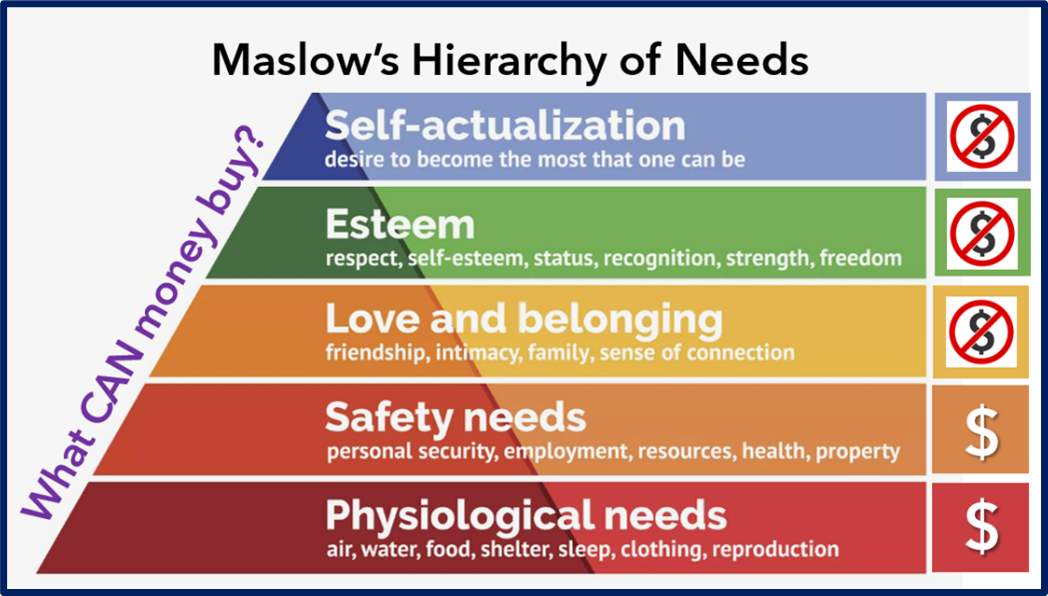
True friendships, family connections, self-actualization and esteem, personal achievements, a bountiful heart, and a strong sense of purpose – cannot be purchased with money, and all have a deeper, intrinsic determination of our happiness. Money has a diminishing rate of return for these important contributors to our happiness.
American Psychologist Abraham Maslow created the Maslow hierarchy of needs in 1943 that theorized what humans need and put forward that people are motivated by five basic categories of needs: physiological, safety, love, esteem, and self-actualization. Again, as you can see, money can help you acquire the basic necessities and comforts of life, but as you elevate your needs, the abilities of money to help you attain these desires diminishes.
How Do You Measure Happiness?

The answer to this question is different for everyone. It depends on what is meaningful to you, what fuels your life, and nurtures your personal development and satisfaction.
Over the past few years, the pandemic provided everyone an opportunity to reassess their lives and what makes them tick, what isn’t working for them, and what they want to harness for the future. Authenticity in personal lives, fulfilling careers, and meaningful relationships took a front seat.
Have you thought about what helped create a sense of happiness for you this year? Now is a great time of year to take a step back and assess your level of contentment and reflect on the blessings you’ve received. When thinking about this, consider your health, your emotional wealth, and your mental wellbeing.
Did you lose sight of some items that are integral to your overall wealth? Are you healthy? Are you emotionally satisfied? Are you mentally recharged and capable of handling what life throws at you?
Taking the time to sit down and reflect on the positive aspects of your experiences and what you can appreciate this year can help you discover what truly makes you happy.
 Have you heard the phrase, “perception is reality?” In other words, something will be exactly as you perceive it to be. Perception is a powerful player in one’s happiness. Those who chose to focus on the negative, will have a negative experience. Those who choose to focus on the positive even in rough situations, tend to be more content in any situation. Do you have a habit of focusing on what happened to you and what went wrong? Or do focus on the “silver lining” of even a bad situation? Even our greatest difficulties provide the seed for equal and greater opportunity. When you change the way you look at things, the things you look at begin to change.
Everyone understands that we cannot choose what happens to us, but we can always choose how we react. The only thing that we continuously have full control over is the power of our own minds. Some people perceive an income of $75,000 plentiful, while others may feel destitute at even much higher incomes. One person can be a multi-millionaire but live a lonely and unfulfilled life. Another could have a strong family support system, have a career they love but barely pays the bills, but their happiness seems endless. As one of the best NCAA coaches ever, John Wooden, said, “Things turn out best for people who make the best of how things turn out.”
As your wealth manager, one of the major contributors to our happiness is the long-term relationships we have with our clients We understand that having a good financial professional can help make your journey easier and we appreciate your trust and confidence in our services. The joy we receive from helping grow and protect wealth for our clients is abundant!
As always, we are here to help and are available to review your unique situation. We will always consider your goals as well as your feelings about risk and the markets when providing any recommendations.
Our aim is to always provide you first-class service, including:
- consistent and effective communication
- regular client meetings, and
- continuing education for members of our team on the issues that affect you.
The Federal Reserve and Interest Rates
The Federal Reserve left interest rates unchanged at their meeting on November 1st. They continued to state that they are closely tracking inflation and the health of the economy to determine their future decisions. During this session, the central bank voted unanimously to leave its primary interest rate in the range of 5.25% to 5.50%. This still leaves U.S. interest rates the highest investors have seen in over 23 years.
While the Federal Reserve held interest rates steady at this session, they left the door open to a further increase in borrowing costs with a policy statement that acknowledged the U.S. economy’s surprising strength, but they also recognized the tighter financial conditions faced by businesses and households.
The Fed meets eight times a year, and it has now left rates unchanged for two meetings in a row. This has not happened since before March 2022, when they first started raising rates at a rapid pace.
In their statement, the Federal Reserve’s Open Market Committee said the economy has continued to grow at a strong pace and while the jobs market has weakened in recent months, it remains strong. They also noted that inflation remains high.
“The rise in long-term interest rates in recent months has had the same desired effect of monetary tightening, effectively doing some of the Fed’s dirty work for them,” according to Greg McBride, chief financial analyst for the financial services company Bankrate. He noted that the Fed didn’t need to raise its benchmark rate because other interest rates have continued to rise.

Interest rates on loans such as mortgages have gone up sharply over the last year, and so have payments on Treasury bonds and interest-bearing accounts. The Fed acknowledged in their statement that tighter financial and credit conditions would likely curb spending by households and businesses.
Since the Federal Reserve’s last meeting in September, new data has shown that inflation is continuing to gradually come down. While it is still not clear if inflation is coming down fast enough, or if inflation will reach the 2% annual level the Fed says it wants to see, for November, the Fed has paused their increases. The projections made by members of the Federal Open Market Committee show that policymakers think it will take until 2025 or 2026 to get inflation to the 2% level.
One of our goals as your financial professional is to maintain a watchful eye on any changes that may affect your situation. Interest rates can play a vital role in your financial planning.
Market Minute | November 02, 2023
While this week’s #market gave some reprieve, we still need to be diligent. See what Dan has to say about #bonds, #duration, and #retirementplans in this week’s #marketminute.