
Due Diligence
Market Minute | Aug 22, 2024
What’s the #hottopic everyone is talking about?
#InterestRates Tune in as Dan discusses #rates, #bonds, #inflation, and the #FED for today’s #RWM #marketminute. #stayinformed #educatedinvestor #wealthmanagement
Market Minute | Aug 12, 2024
Happy Monday from LPL’s 2024 National Conference!
Understanding Volatility and the Benefits of a Long-term Investing Strategy
Investors typically include equities in their long-term plans with the expectation of generating a positive return. Historically, over longer periods of time, this strategy has helped many investors achieve their desired goals. While it would be accommodating if equity markets presented a simpler way to generate investor returns, that is not the case. To produce equity returns, an investor needs to understand that many factors, including interest rate movements, inflation, economic activity, geopolitical events, and corporate earnings, can affect the daily, monthly, and even annualized rate of equity returns. Considering these uncertainties, a qualified financial professional will customarily meet with clients to understand their personal situation, timelines, and objectives. At that point, a long-term strategy can be outlined so an investor can prepare for the potential dips and dives that equity investing can include.
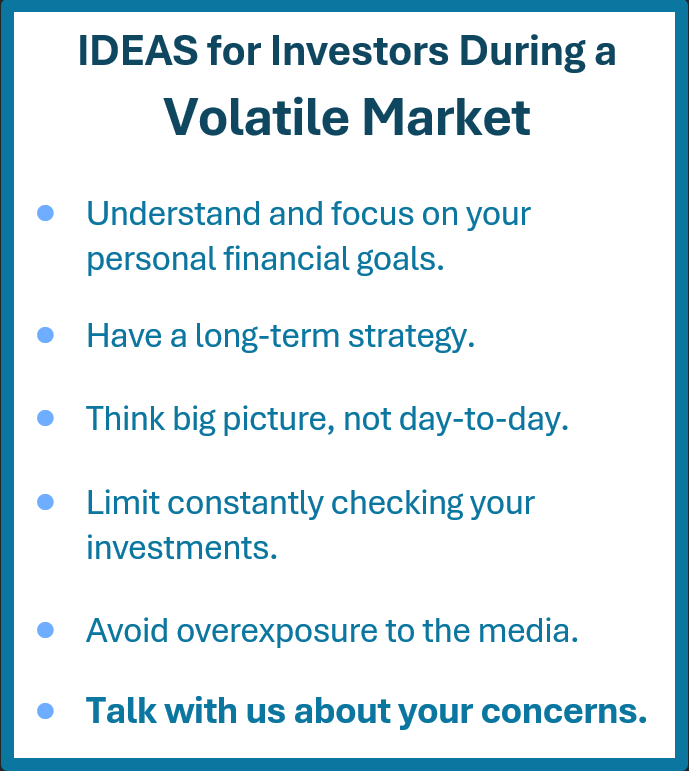
The equity markets recent volatility, or rapid changes in equity prices, have presented an opportunity for us to reinforce that, while investors cannot control equity market movements, they can control their behavior and the decisions they make when this type of turbulence occurs.
This year, there has been a considerable volume of uncertainty in the economic environment. Despite this, the stock market has managed to overcome numerous challenges. The Federal Reserve is currently facing the arduous task of steering the economy toward an economic recovery with a hopeful soft landing. However, there are worries that the U.S. may not achieve this soft landing and could instead experience a period of recession. As a result, market volatility has increased significantly in recent weeks.
There is great concern that the Federal Reserve has been slow to respond to signs of a weakening economy and may need to cut interest rates quickly.
Market Minute | Aug 05, 2024
Just another #ManicMonday? Tune in to hear Dan’s thoughts on the #market #volatility, potential #causes, and how that #impacts #investing. #RWM #MarketMinute #stayinformed #educatedinvestor #CFP
Market Minute | July 19, 2024
#Tecnology #outages #RWM
#Tecnology #outages are no way to start the weekend. In today’s #RWM #MarketMinute, Dan talks #systems, #trading, and the #global impact we are experiencing when technology fails. #stayinformed #educatedinvestor #wealthmanagement #CFP
Quarterly Economic Update Second Quarter 2024
Equity and bond markets began the second quarter of 2024 with a rough start, thanks to the Federal Reserve’s decision not to reduce interest rates due to stubbornly high inflation rates. However, during the quarter, strong performances from companies tied to artificial intelligence and a more favorable outlook on inflation numbers changed that perspective, and investors saw multiple all-time-high days, and many records were set for equities. Markets improved in May, and during the quarter, 31 records were set for the S&P 500. As a follow-up to the strongest first quarter since the pre-pandemic days of 2019, investors continued to enjoy the bull run in the second quarter.
Big tech and large communication companies contributed disproportionately to the equity market’s rise. The continued confidence in artificial intelligence and the prospect of it ushering in a new era of technology helped fuel the S&P 500. The boom in the technology sector of the market is being led by companies referred to as the “Magnificent Seven.” For the first half of 2024, these seven companies, Alphabet, Amazon, Apple, Meta Platforms, Microsoft, Nvidia, and Tesla, have all helped drive the market. For the quarter, Nvidia alone advanced Morningstar’s U.S. Market Index by 1.6%.
As June ended, all three major indexes were up for the year, with the S&P 500 up approximately 15% and the Dow Jones Industrial Average (DJIA) rising almost 4%.
For the second quarter, the S&P 500 returned nearly 4% and closed at 5,460.48. The Dow Jones Industrial Average (DJIA), which has less of a tech influence, crossed a new milestone of 40,000 in May but ended the quarter at 39,118.86, down about 1.7%. (www.cnbc.com; 6/28/2024)
KEY TAKEAWAYS:
- Equity markets closed out the first half of 2024 with strong results.
- The Fed held the federal funds rate range steady at 5.25 – 5.50%, with no changes in the second quarter.
- The Fed is no longer anticipating three rate cuts as previously expected.
- Inflation rates are still above the Fed’s desired 2% goal.
- Both the economy and equity markets remain strong.
- Staying the course and maintaining the consistency of a well-devised, long-term focused plan has historically served investors well.
Click here to download a PDF of this report.
Converting 529 Plans to Roth IRA
A significant benefit has come to fruition on December 29, 2022. President Biden signed the “Consolidated Appropriations Act of 2023”, which included the “SECURE 2.0 Act of 2022”. Well, now, starting from January 1, 2024, any remaining funds in a 529 account can be shifted tax-free to a Roth IRA.
This change means it’s time to rethink how we see 529 accounts. They’re not just for college savings anymore; they’re versatile tools for tax-advantaged investing, covering both education and retirement.
Per Chris Stack, Managing Consultant for SavingForCollege.com, here are the key points:
- 1. The 529 account must have been maintained for a minimum of 15 years, with the same owner, same designated beneficiary (“DB”) and likely in the same 529 plan*. Owners of 529 accounts should no longer be looking to close older 529 accounts but rather considering whether such accounts should be kept open to benefit from this 15-year requirement.
- The amount being transferred (including the earnings attributed thereto) must have been contributed at least 5 years prior to the transfer. There is no prohibition to such 529 account continuing to be funded even after the first transfer to the Roth IRA, so it is possible that amounts not originally eligible may be so transferred in a later year.
- The 529 Account is a source for Roth IRA funding subject to the annual limit (currently $6,500 for <50 years) and must be net of any other contributions such year. This is distinguished from the conversion of a traditional IRA to a Roth IRA which may be done at once with the full balance of the traditional IRA but with the payment of taxes at the time of such conversion.
- The amount so transferred is limited to an aggregate $35,000. It is unclear if such aggregate limit applies to each such account or is applicable to each DB*.
- The Roth IRA must be that of the 529 account’s original DB only*. The 529 account owner has always had the option of changing the designated beneficiary to any other qualifying family member as often as they wish but that is likely to re-start the 15- time required period.
- The transfer to the Roth IRA must be a trustee-to-trustee transfer similar to a rollover between 529 plans with the earnings history following the account. Indirect transfers where the account owner takes a distribution to re-invest within 60 days does not qualify for the transfer to the Roth IRA.
- The income limits applicable to a Roth IRA are not applicable to transfers from the 529 account.
- The 529 account owner remains in control and decides the timing and application of funds in their account, including whether to so transfer funds to the DB’s Roth IRA.”
This change opens up new possibilities for 529 plans, adding to their existing benefits like tax-free growth, protection from creditors, and estate planning advantages. Keep in mind, though, that state tax laws might differ from federal ones, so it’s wise to stay updated on any state-specific regulations.
Please note this is for informational purposes only and is not intended as tax, legal or investment advice. The topics covered may undergo changes in law and interpretation without prior notice. Additionally, as per IRS Circular 230, it’s important to note that any U.S. tax advice provided in this communication is not intended for the purpose of evading U.S. tax penalties and should not be relied upon as such. Lastly, be sure to consult with your tax professional on any item outlined in this article.
*- The Act empowers the U.S. Treasury (IRS) to address related matters in notices, regulations etc.
Market Minute | June 21, 2024
Happy Friday! Tune into this week’s #RWM #MarketMinute to hear Dan’s thoughts on the #MagnificentSeven, #SP500, and #Pfizer.
#stayinformed #educatedinvestor #wealthmanagement #CFP
Common Investing Mistakes
Whether someone has $50,000 or $5,000,000 to invest, there are several investment pitfalls that any investor can fall into. One of our goals as financial professionals is to help clients avoid these pitfalls, which could be very costly. We have come across many mistakes and firmly believe that it could be much easier and less expensive to learn from others mistakes, rather than make them yourself.
Over the years, we have found the following items to be the most common investing mistakes we see investors experience. If you feel that you are or have been affected by any of these, please contact us and we would be happy to reassess your personal financial situation.
Unclear Goals
Most investors attempt to make the most of their investments. Being proactive and having clear goals and objectives in mind can help you optimize your situation. Benjamin Franklin coined the phrase, “If you fail to plan, you plan to fail,” and this holds merit when it comes to your investing strategy.
Once you have determined your goal, creating a comprehensive plan that will help you weather anything that equity the markets can bring is recommended. The last few years have taught investors that anything can happen so it’s healthy to plan for the possibility of expecting the unexpected. Not having a well devised plan that considers your risk tolerance, investment horizons, and investing habits, could reduce your ability to optimize your investments or worse, cost
you over time.
Your clear goals will help you stay focused and help dissuade you from going off course in times of uncertainty and volatility.
Choosing Your Investment Strategies Based on Someone Else’s Situation
“This is what my smart friend is doing,” is usually not a phrase that should follow when choosing your investment strategy. It’s easy 2 52 0 N. Sant iag o Blvd | Ora ng e, CA 92 86 7 | 71 4.5 47. 878 7Common Investing Mistake to Avoid to look at what someone else is doing and, if they are having success with it, be tempted to do something similar. However, their situation may be entirely different than yours: their starting point of entry could vary; their short-term and long-term needs could be different; they could have a higher risk tolerance; and their time horizon could be longer or shorter than yours. There are too many variables to entertain a strategy because, “someone else is doing it.” We understand that the infamous pressure of FOMO (Fear of Missing Out) could rear its ugly head when someone is having success with one strategy, but jumping on board that strategy without taking into consideration your unique situation could be a costly mistake. This is sometimes referred to as the bandwagon effect – a phenomenon in which people do something primarily because other people are doing it.
Choosing investment strategies should involve critical consideration and thinking. With the help of an investment professional, do your due diligence before making any investments strategy changes or moves.

Market Minute | May 30, 2024
In today’s #RWM #MarketMinute, Dan discusses how #headlinenews can impact your #portfolio #performance – specifically due to the #volatility during an #election year. #stayinformed #educatedinvestor #wealthmanagement #cfp